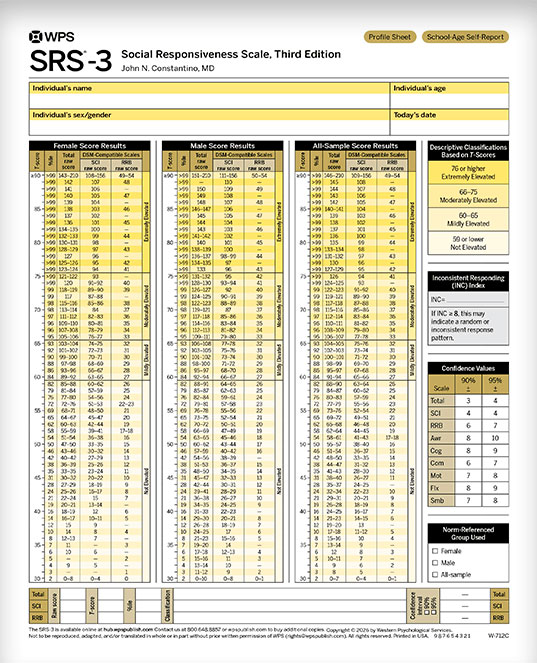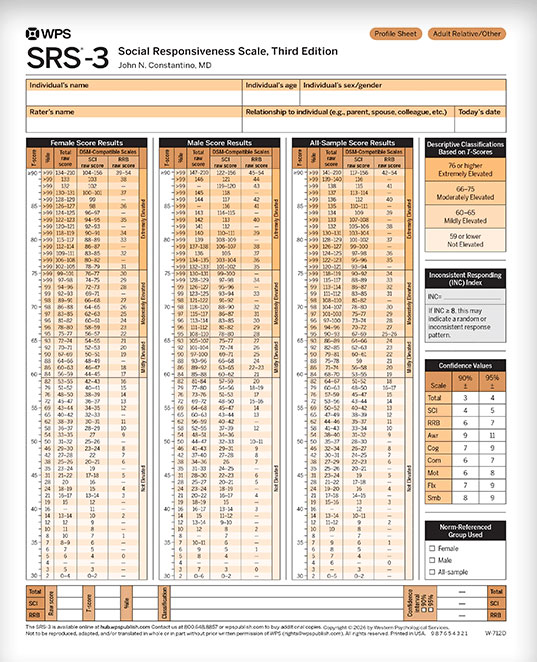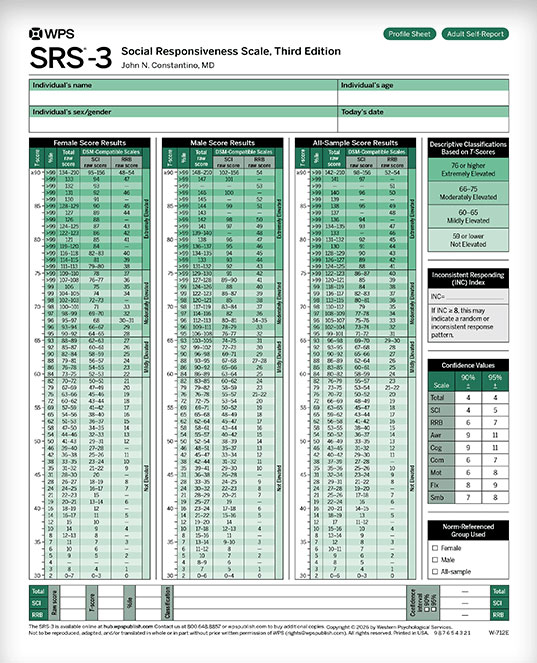
by John N. Constantino, MD
Purpose: Measures social responsiveness and autism-related behaviors across the lifespan to support confident diagnostic decision-making and intervention/treatment planning
Age: 2.5 years through adulthood
Time: 15 to 20 minutes per form
Format: Parent and/or teacher rating scales for ages 2.5 through 18 yrs
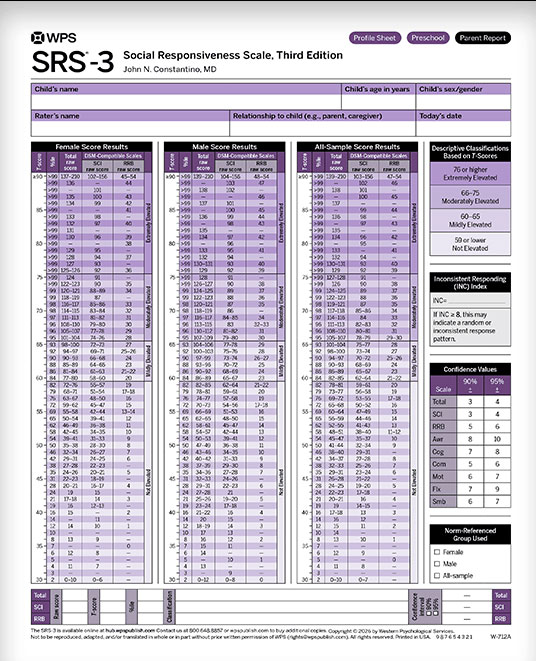
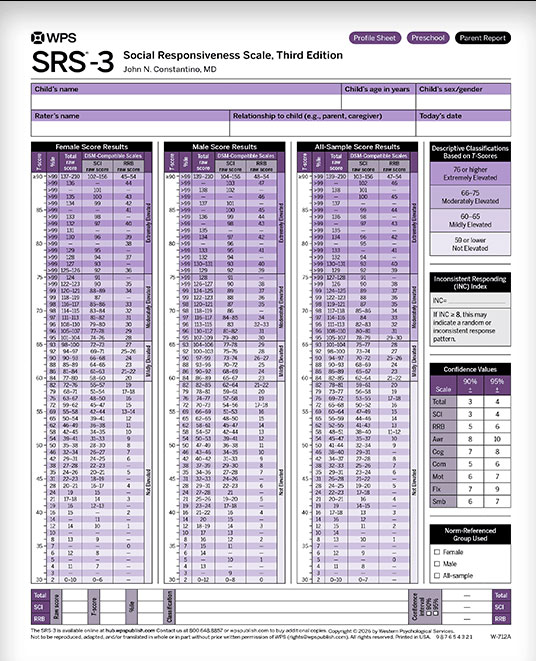
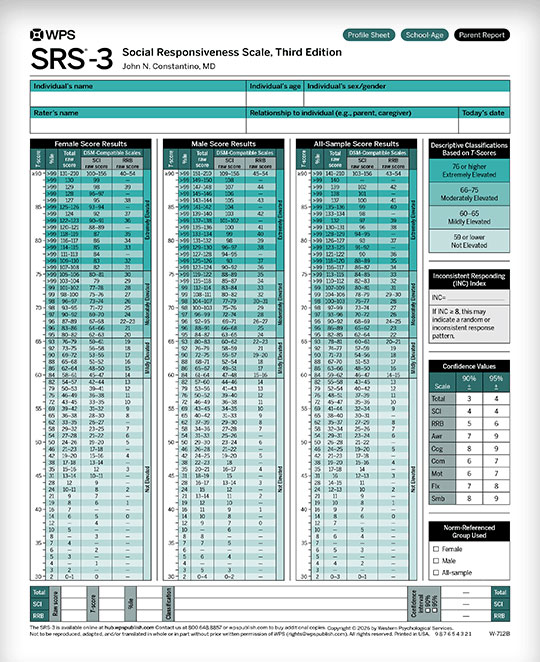
Scores: Total Score; 2 DSM-Compatible Scale scores; 6 Treatment Subscale scores; Inconsistent Responding Index
Norms: Provided separately for each form; based on a sample of 1,180 individuals (2,340 ratings); nationally representative in gender, ethnicity, education, and geographic region; separated by rater type as well as age and gender of individual rated
Qualification Level: B
COMING SOON OCTOBER 2026 - PRE-ORDER NOW
A Clearer, More Complete View of Social Behaviour for Autism Evaluation
The Social Responsiveness Scale, Third Edition (SRS®-3) is a norm-referenced rating scale that measures social responsiveness, the ability to engage in reciprocal, socially appropriate interactions, and autism-related behaviours across the lifespan.
As part of a comprehensive evaluation, the SRS-3 enables practitioners to gather structured behavioural data for diagnostic decision making, school eligibility determinations, treatment/intervention planning, and progress monitoring.
Results from the SRS-3 can be used in a variety of settings to:
- support diagnostic decision-making for autism and related conditions;
- assess social communication challenges in individuals with non-autism conditions, such as attention-deficit/hyperactivity disorder (ADHD), social (pragmatic) communication disorder, or anxiety;
- plan and monitor interventions and other treatments designed to improve social responsiveness; and
- facilitate research on the prevalence, presentation, and inheritance of autism and related conditions.
What the SRS-3 Measures
The SRS-3 provides three types of norm-referenced T-scores: SRS-3 Total Score, two DSM-Compatible Scale scores, and six Treatment Subscale scores.
- The SRS-3 Total Score is a global index of social responsiveness based on the frequency of observed behaviours. This is the primary score used for measuring the extent of autism-related behaviours assessed by the SRS-3.
- The DSM-Compatible Scales assess autism-related behaviours aligned with the two criterion domains for the identification of autism. These scores are intended to provide additional context for the SRS-3 Total Score and inform decisions about diagnosis and eligibility
- Social Communication and Interaction (SCI)
- Restricted Interests and Repetitive Behaviours (RRB)
- The Treatment Subscales measure specific types of behaviour related to reciprocal social interaction and the characterising traits of autism.
- Together, these scores describe patterns of behaviour that may inform clinical interpretation, treatment plans, and other interventions.
- Social Awareness
- Social Cognition
- Social Communication
- Social Motivation
- Cognitive Flexibility
- Sensory-Motor Behaviour
What’s New in the SRS-3
While the SRS-3 retains the essential characteristics of the previous editions, the new revision also includes the following improvements:
- Updated standardised T-scores derived from a nationally representative normative sample
- Three norm options for all forms: female, male, or all-sample, which includes all individuals regardless of sex or gender identity
- A new School-Age Self-Report Form for children and adolescents ages 11 through 18 years
- New items capturing the presence of reciprocal social skills in addition to social communication challenges
- Updated item wording for clarity and inclusivity, including gender-inclusive terms and more neutral, behaviour-focused language in line with modern approaches for describing neurodivergent behaviour
- Separation of the Restricted Interests and Repetitive Behaviours (RRB) Treatment Subscale into two Treatment Subscales: Cognitive Flexibility (Flx) and Sensory–Motor Behaviours (Smb)
- A new Inconsistent Responding Index (INC), designed to help identify random response patterns indicative of low-reliability ratings
- New clinical validity studies including individuals with autism, ADHD, anxiety disorders, intellectual and developmental disorders, and other clinical conditions
- Updated and expanded interpretation guidelines, including new information on interpreting the scale and subscale scores
- New digital administration and scoring options, including advanced reporting options, via the WPS Hub™
How the SRS-3 Fits into an Evaluation
Paired with observations, interviews, and other standardised tools, the SRS-3 adds structured behavioural data from those who see the individual in everyday life, strengthening clinical decision-making when evaluating for autism.
Use the SRS-3 to:
- Support differential diagnosis between autism and other conditions
- Strengthen clinical reports with quantifiable multi-respondent data
- Compare ratings across respondents and identify meaningful discrepancies
- Inform intervention planning at the subscale level
- Track change over time across administrations
- Communicate findings clearly to families and educational teams
Assess Across the Lifespan
Forms include:
- Preschool (2:6–4:6): completed by a parent/primary caregiver or teacher/other professional
- School-Age (4:0–18:11): completed by a parent/primary caregiver or teacher/other professional
- School-Age Self-Report (11–18:11): completed by the child or adolescent being assessed
- Adult Self-Report (18 and older): completed by the adult being assessed
- Adult Relative/Other (18 and older): completed by a family member, spouse, partner, friend, or colleague
Digital Administration
WPS Hub™ gives you flexible administration, scoring, and reporting for the SRS-3:
- Administer remotely or in person
- Use the optional printable response sheet for raters without online access
- Send a secure link to respondents to access forms and provide ratings
- Validate ratings and score automatically, with results available immediately
- Generate Reports
- Interpretive Report to clearly visualise results, plus Rater Feedback option for easy explanation to raters
- Rater Comparison Report to identify discrepancies (up to five raters)
- Cross-Time Score Comparison Reports to track change over time
- WPS Hub users will have automatic access to the SRS-3 Digital Manual.